This work is defined by its refusal to move directly.
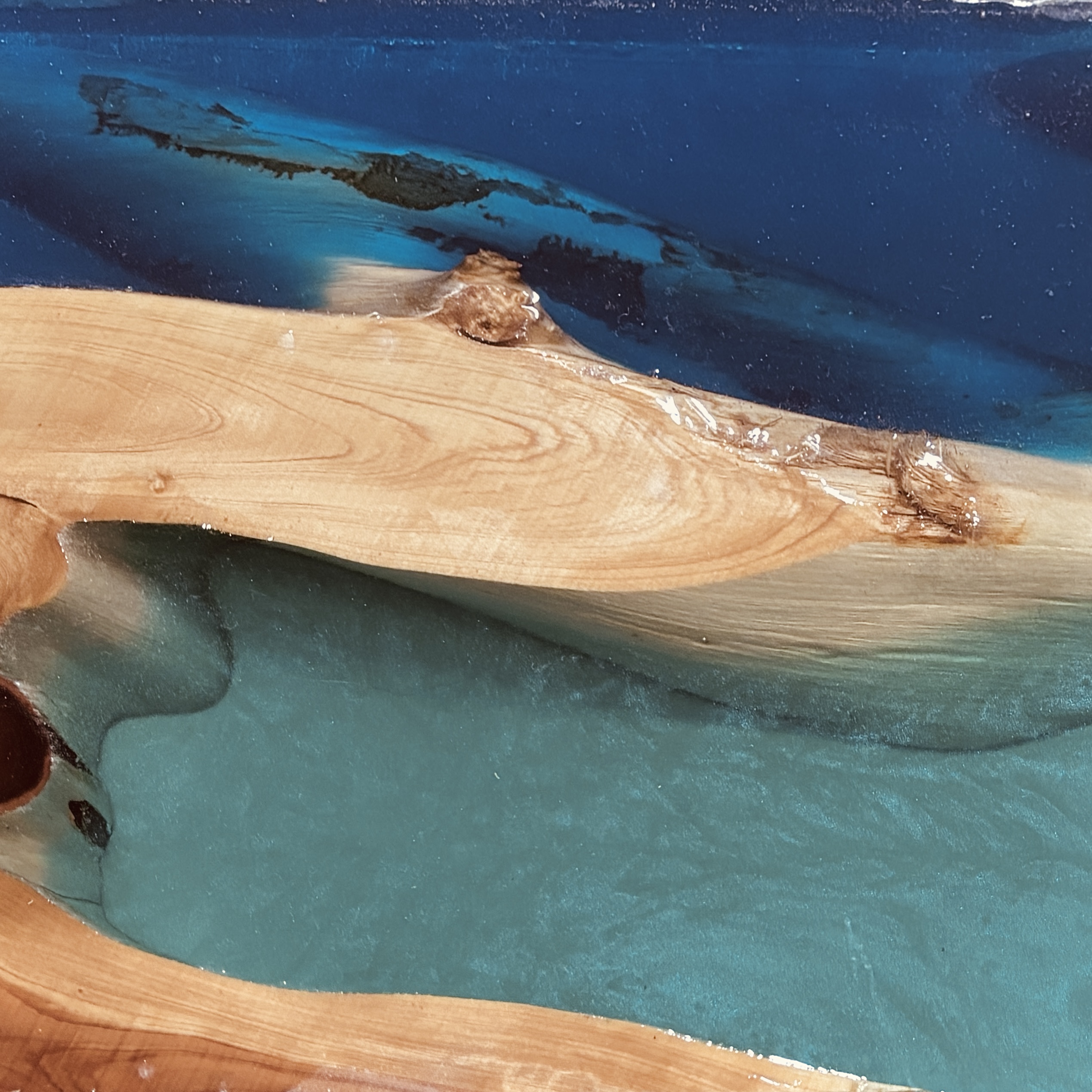
At first glance, a channel appears — a clear passage carved between masses of wood and fields of blue. Yet the route does not behave as expected. It bends, narrows, widens, and subtly shifts its tone, as if resisting efficiency. This is not a channel designed for speed. It is a channel that remembers hesitation.
The blue carries depth, but not urgency. It feels layered rather than fast, suggesting accumulated movement rather than a single decisive flow. The darker upper band presses down like a distant horizon, while the lighter turquoise below opens space, creating a vertical tension within the same direction. Movement exists, but it is stratified.
The wooden forms act as both guides and obstacles. Their grain runs parallel to the flow in places, then cuts against it, introducing friction. The channel is not free — it is negotiated. The path exists only because resistance exists alongside it. This dialogue between permission and constraint gives the work its emotional charge.
Light traces the channel delicately. Reflections skim across the surface, emphasizing direction without overpowering it. Nothing is dramatic. Nothing breaks. The motion is quiet, almost administrative — like a route used daily, unnoticed, yet essential.
In TAKAMASA MASAKI’s work, this piece balances precision and feeling. It is architectural in structure but emotional in implication. The channel becomes a metaphor for chosen paths, compromises, and the elegance of moving forward without certainty. It suggests that direction does not require clarity — only continuity.
“A Route That Refuses to Be Straight” is not about arrival. It is about persistence. About allowing movement to remain imperfect, slightly misaligned, and still valid.
The channel holds.
The movement continues.
Not because it is easy —
but because it must.
year : 2025
material : juniper, resin
collection : #CHANNELS